
Calendar
AUV offers its courses over an academic year comprising two 16-week semester and two optional 6-week summer sessions. Key dates for the academic year 2025-26 are given in the schedule below.
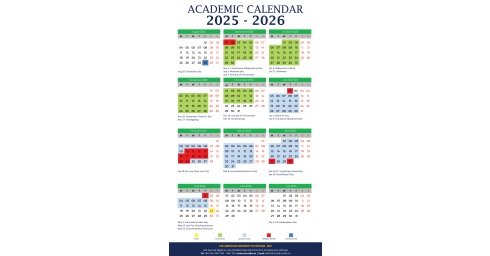
- SPRING SEMESTER 2026
- FALL SEMESTER 2025
Curricular Structure
Curricular Structure
Our programs are centered on the philosophy of liberal education, providing our students career paths grounded in a rigorous general core curriculum. Our students will develop their analytical, logical, mathematical, and communication skills while cultivating 21st Century social, cultural, and global perspectives.
Our diverse majors will build upon the general studies foundation to prepare students for careers that capitalize on specialized knowledge, mature decision making, and a spirit of innovation. Graduates will lead their personal, professional, and social lives with the knowledge, skills and values required to produce lifelong achievements.
Breakdown of the AUV curricula:
1. UE Prep (University English)
2. AUV Degree Requirements
3. General Core and Major Courses Insight
Learning Outcomes
Build a foundation for career development…
Command a sense of global understanding that includes…
Develop a genuine interest in learning that remains for life.

Connect with individuals and communities…
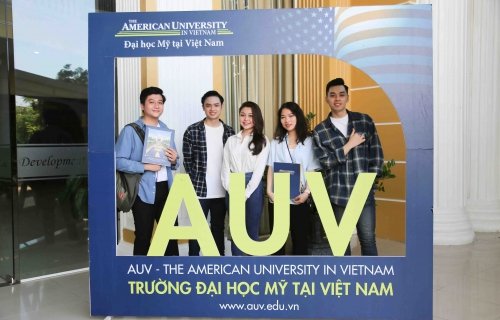
Demonstrate the ability to speak, read…
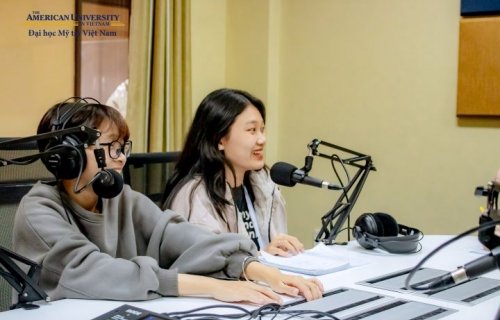
Apply knowledge from various fields…

Think critically and communicate their work…
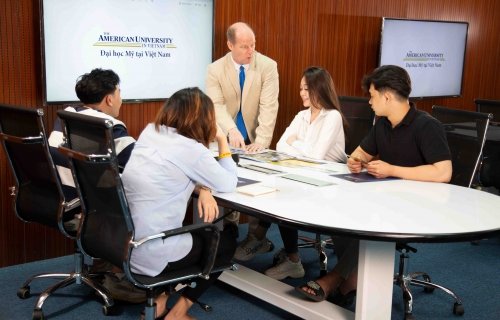
Cultivate a sense of community connectedness…

Locate and evaluate information,…

Reinforce and expand a system of personal values…

University Preparatory Program
University Preparatory Program
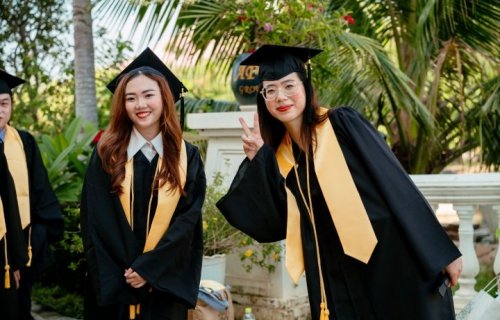
University English is a comprehensive program designed for incoming students who need to build their English proficiency for academic success across the disciplines. This program provides a supportive environment where students can strengthen their abilities in reading, writing, listening, and speaking. It is tailored to address the unique challenges faced by those transitioning from local high school or non-English speaking backgrounds into the world of American-style higher education. After completing UE coursework, students emerge as well-rounded communicators, ready to tackle interdisciplinary challenges and contribute meaningfully to the academic community at AUV.
General Studies Program
General Studies will develop students' analytical abilities, computational and communication skills along with helping them gain social, cultural, and global perspectives. Our General Studies program is built on three pillars: • Developing students’ Core Skills, especially written and oral communication in English, critical thinking and reasoning, and group and social collaboration. • Providing students with knowledge of science and technology, social sciences, arts, and humanities. • Providing opportunities for students to integrate their learning in multicultural, interdisciplinary, and community contexts.
GENERAL EDUCATION DISTRIBUTION REQUIREMENTS
Students will complete most general core courses in their first two years of school. After the first two years, students will be expected to focus on their major courses along with upper division electives (200-300 level).
The following rules apply to courses required in General Core Courses:
None of the following can be used to satisfy any of the required courses in the General Education requirement: a course waiver, Advanced Placement test score, International Baccalaureate exam, Independent Study course or a course taken as Credit/No Credit.
Courses transferred from accredited universities may be acceptable if those courses are equivalent in contents, as determined by qualified AUV faculty members.
Course may satisfy more than one discipline group. For example, ECON 202 may satisfy both the General Education and the Business requirements.
At least 50 credits must be taken to satisfy the General Courses. If an instructor determines a course to be too introductory for a particular student (based on qualifications, prior experience or passing course tests), the student must take an advanced course in the same category to meet the minimum 50 credits of General Core Courses. For example, if the instructor exempts a student from taking ENGL 105, the student may take an advanced COMM course or ENGL course (e.g., Creative Writing, or Introduction to Fiction) in place of ENGL 105 to meet the minimum credits required in the communication category.
GENERAL STUDIES (50 – 60 CREDITS)
As a student in the transfer program pathway, a majority of your course schedule will consist of general core courses. You should expect to complete between 50-60 credits over two academic years (4 semesters).
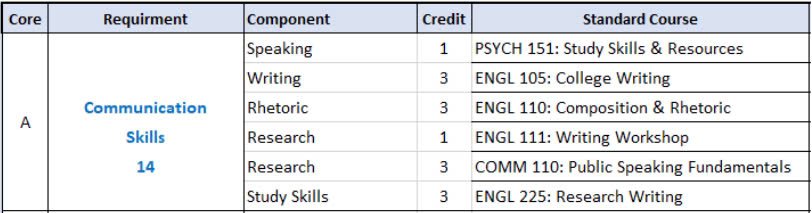
A. Required Courses in Communication Skills (14 credits)
AUV requires coursework in humanities and arts. The minimum requirements are as follows:
B. Required Scientific Inquiry and Analytical Reasoning (14 credits)
Math and Sciences are a gateway to understanding nature. These areas of knowledge include:
• Tools of Quantitative Reasoning, including Mathematics, Statistics and Computer Applications.
• Natural Sciences covering physical, life and environmental sciences. Physical Sciences examine the nature of things, such as physics, chemistry, and astronomy.
Life Sciences examine the nature of life, such as biology, physiology, zoology, and botany. Environmental sciences examine the interaction of nature with humans.
The minimum requirements for meeting the math and science are as follows:

C. Required Courses in Thinking and Creative Expression (6 credits)
Social Sciences are a gateway to understanding society and the human side of nature. This category of knowledge examines social institutions, relations, and behaviors. The minimum requirements for meeting the Social Sciences area of knowledge are three credits from each of the following groups:

D. Understanding Society and Human Behavior (9 credits)
Students will gain insight into the economic principles that drive society, understand how society functions, and gain insight into human behavior

E. Perspectives & Values (10 credits)
Humanities are a gateway to understanding the complexity of individual self and their modes of expression. This category of knowledge sheds light on human thoughts and reasoning, creativity, languages, literature, and history.


Major Requirements
Major Study refers to the area of concentration, specialization, or emphasis. Courses in the Major Study incorporate active learning strategies, emphasizing conceptual learning with applied hands-on experience, practical applications, group exercises, and long-term projects.
HOSPITALITY MANAGEMENT & RESORT LEADERSHIP
Tourism and Hospitality Management are important industries in Vietnam as they contribute to the economy and affect the natural environment and ecosystem of Vietnam. The Hospitality Management & Resort Leadership is designed to address economic development, business performance and social responsibility, and environmental and social concerns. This program is available in collaboration with Arizona State University (ASU). Students can complete their General Education courses as well as select technical courses at AUV before furthering their education at ASU. The program is particularly suitable for careers in tourism, hotel management, sustainable business, environmental agencies, MICE (meeting, incentive, conferences and exhibition), recreation and sports management, and national and local governments.
AVIATION MAINTENANCE TECHNOLOGY & AVIATION MAINTENANCE MANAGEMENT
Since 2005, APU has collaborated with select universities in the United States for training more than 100 employees of Vietnam Airlines Corporation in areas of Aviation Maintenance Engineering and Aviation Maintenance Administration. The Aviation Maintenance Technology & Aviation Maintenance Management program is available in collaboration with Arizona State University (ASU) and Florida Institute of Technology (FIT). Students can take their General Education courses as well as select technical courses at AUV before furthering their education at Florida Institute of Technology (FIT) or Arizona State University (ASU) . The program can be tailored for careers in the aviation industry in Vietnam and ASEAN.
BROADCAST JOURNALISM
Broadcast Journalism plays a vital role in society. It keeps us informed of what’s happening in the world around us, updates us on the things we really need to know, and does so in a way that’s accessible for everybody. Journalism students learn how to find story ideas, conduct interviews and other research, write in a variety of styles, produce video reports, take photographs and publish on both traditional and new media platforms. In the concentration, you will learn by doing: In many of our courses, you will get practical, hands-on experience, generating news content that will be seen by the public.
COMMUNICATION & MEDIA
Communication & Media focus on Journalism, Public Relations, Advertising, and Video Production. This program is offered as a collaboration between AUV and Virginia Commonwealth University (VCU), offering a Bachelor of Science in Communication & Media with concentrations in one of four areas: advertising, journalism, video production or public relations. Students can enroll in a 4+1 program—four years for the BA degree at AUV and one year at VCU for the master’s degree. Alternatively, students can select from a variety of options, such as 2+2+1 or 3+1+1 mode of study. AUV students can also earn their degrees in a shorter time by studying three years and two summer sessions at AUV and one year at VCU for the master’s degree.
EDUCATION (ESL EMPHASIS)
Teaching English as a Second Language is a high-demand subject of instruction that continues to experience growth in schools across the country. ESL majors acquire a deep understanding of the English language history, multicultural language, linguistics, composition, and speech, all the while learning the key skills needed to address all learners’ needs in a changing diverse society. Particular emphasis is placed on cultural and linguistic diversity, integration of media and technology, multi-level teaching, and standards-based assessment.
GLOBAL BUSINESS MANAGEMENT
Our Global Business Management major is suitable for those with career plans in international commerce fields, such as careers in import/export companies, multinational enterprises, global supply chain operation, international banks and investment funds, regional development banks, transnational franchising, international corporate finance and accounting, foreign currency exchange, international marketing and human resource management, foreign business representative office, tourism and hospitality, or cross border shipping, transportation, logistics, management, and e-commerce. Upon graduation students my pursue their education for a master’s degree in the U.S., such as Thunderbird School of Global Management.
MULTIDISCIPLINARY ENGINEERING (AERONAUTICAL ENGINEERING)
The Aeronautical Engineering curriculum provides a thorough background in fluid dynamics, structures, propulsion, controls, flight dynamics and design. The curriculum provides flexibility with regard to all areas of potential aerospace practice by emphasizing applied science, design, and technology while providing a firm foundation in mathematics and physics. With a strong science and mathematics based education, aerospace engineers have also found employment opportunities outside of the traditional aerospace industry.
ENTREPRENEURSHIP
The Entrepreneurship concentration empowers students to develop an entrepreneurial mindset and complementary skill set needed to provide creative solutions for new ventures and existing organizations. Students gain knowledge of entrepreneurial and design concepts useful for questioning assumptions, exploring alternatives and developing creative solutions.
PUBLIC RELATIONS
The Public Relations major balances theory and practical application to teach you to skillfully manage public relations strategies for all types of organizations, including corporate, non-profit, government, and political. Public relations professionals communicate their company’s brand messages and foster relationships with the media and the public. They generate publicity through communications campaigns, write speeches and prepare press conferences, arrange interviews with reporters, act as spokespeople, and write news releases, feature stories, web pages, and social media content. They’re concerned not only with what their organization wants to communicate, but also what target audiences need and want to know.
BUSINESS ADMINISTRATION
Business Administration is a popular major at AUV. It is designed to provide in-depth knowledge and skill in various fields of business, such as entrepreneurship, finance, leadership, human resource management, marketing management, accounting, banking, e-commerce, accounting, and supply chain operation. Students can pursue careers in banking, public companies, startups, investment firms, small and medium size business, manufacturing, sales, online service, accounting and finance, consulting, and social enterprise.
This major has a General Studies component, a major core, and electives. The General Education courses are listed below and the major core courses are similar to those of our partners. Electives include specialized courses from both AUV and partner universities.

GLOBAL STUDIES
The Global Studies program at AUV offers courses in a variety of international-related fields, such as International Institutions and Agencies, International Relations, International Law, Cross Cultural Management, International Economics, Climate Change and Environmental Sustainability, Foreign Trade, World History and Cultures, World Geography, Economic Cooperation and Partnerships, and Foreign Languages. Upon graduation, students may pursue a master’s degree in the U.S., or pursue careers in foreign representative office management, international projects, foreign trade and investment, international health and education, foreign service, tourism and hospitality, international agencies and nonprofits, overseas services, and governmental and NGO (non-governmental organizations).
MULTIDISCIPLINARY ENGINEERING (SOFTWARE ENGINEERING)
Software Engineering is a systematic, disciplined, measurable approach to building and maintaining software. Starting with thorough preparation in mathematics and computer science, software engineering students at AUV learn how to successfully implement and manage the development, maintenance, and evolution of software products.
COMMUNICATION STUDIES
The curriculum for the Communication Studies major requires 45 credits of General Studies, 45 credits of Electives and 30 credits of core communication coursework focusing on oral communication, communication theory, and persuasion. Students who graduate from this program will understand the multiple dimensions of the process of human communication and its various topics of study including rhetoric, interpersonal communication, public communication, group communication, organizational communication, conflict management, and negotiation skills.
Overview
Communication is at the core of everything we do, and it is an essential skill necessary to succeed even in a technology-driven society. Too many times we hear of a miscommunication or misunderstanding that has been the downfall of an organization.
Understanding the many facets of communication that one needs to master to thrive in an ever-changing environment is at the core of AUV’s communication major. Students who select a communication major will gain the knowledge and experience in a variety of core disciplines, providing them the tools to make a successful presentation, broker an important business agreement, or negotiate an international treaty.
Our curriculum embraces personal development as well as professional readiness. The program will help students to become good communicators who will also understand the ethical choices powerful communicators must make.
Our bachelor of arts degree in communication studies is a 4-year program. In the finest tradition of American education, the first two years of the program provide students with a solid academic background in General Studies (42 credits), followed by a set of communication core courses (30 credits) and electives (48 credits).
Special Program Features
Our communication studies program offers a combination of in-class instruction, project-based learning, hands-on assignments, practical experience, and rigorous, methodical analysis. In our program, students learn the knowledge, skills, values, and experiences that international employers demand.
Specifically, students learn how to apply theories to practice; how to foster creativity and innovation; how to detect and solve problems; how to collect, process, evaluate and synthesize information; how to transform information into knowledge and insight; how to write, articulate, report, and make effective presentations; how to plan, formulate and implement creative initiatives to address diverse issues; and how to arrive at effective strategies for meeting the multifaceted interests of diverse stakeholders.
Objectives of Our Communication Studies Program
Upon completion of the communication studies major, our students will be able to:
Understand the multiple dimensions of the process of human communication and its various topics of study such as rhetoric, interpersonal communication, public communication, and communication in small groups and organizations.
Identify the appropriate message construction for a specific communicative environment.
Articulate the role that communication plays in business, art, and education.
Explain messaging strategies for persuasive presentations.
Understand the role that conflict management plays in successful communication.
Develop the ability to think strategically make effective and ethical arguments through whatever communication choices are available.
Identify the role that culture plays in message selection.
Skills Developed in This Program
Our Communication Studies Program helps students develop the following skills:
Presentational speaking with and without enhanced electronic technology.
Critical thinking with respect to message development for specific audiences.
Group management and decision making.
Conflict management and negotiation.
Persuasive messaging for communicative campaigns.
Path to a B.A. Degree in Communication Studies
The path to a degree in Communication Studies at AUV begins with prerequisite knowledge in areas of basic communication principles, research methods, rhetorical theory, and communication theory.
The completion of communication studies core courses and electives provides students a comprehensive understanding of the field of communication and has the flexibility to allow students to focus on individualized areas of interest in communication as possible career paths.
As our students progress through the 4-year program, they will have opportunities to complement their classroom academic experience with practical experience via work-study, internship, and service learning work at national and international enterprises operating in Vietnam or overseas.
The approach of complementing classroom knowledge with practical work skills creates a well-rounded and business-savvy graduate prepared to make positive contributions to the greater community.
Required Coursework
Completion of the Communication Studies degree program requires 120 credit hours of the following academic courses:
General Studies (45 Credits)
ART 100: Introduction to Art (or any other ART course) (3 Credits)
BIO 181: General Biology (or any other course in life sciences) (4 Credits)
ENVI 101: Intro to Human Ecology (or any other natural sciences course)(4 Credits)
CIS 105: Computer Applications & Information Technology (3 Credits)
ENGL 107: Composition I: Introduction to Prose (3 Credits)
ENGL 108: Composition II: Research Writing (3 Credits)
GLOB 305: World Cultures and Societies (or any other GLOB course) (3 Credits)
HIST 101: World History 1500 to Present (or any other HIST course) (3 Credits)
IDS 305: Technology, Culture and Society (3 Credits)
MATH 117: Algebra with Applications (3 Credits)
PHIL 101: Introduction to Philosophy (3 Credits)
PHIL 103: Principles of Sound Reasoning (3 Credits)
POSC 160: World Political Systems (or any sociology or political science course)(3 Credits)
PSYC 101: Introduction to Psychology (3 Credits)
UNIV 100: University Success Skills (1 Credit)
Communication Core (30 Credits)
COMM 105: Introduction to Communication Studies (3 Credits)
COMM 200: Research Methods (3 Credits)
COMM 225: Public Speaking (3 Credits)
COMM 230: Persuasion and Argumentatio (3 Credits)
COMM 301: Rhetorical Theory (3 Credits)
COMM 305: Communication Theory (3 Credits)
COMM 320: Organizational Communication (3 Credits)
COMM 410: Nonverbal Communication (3 Credits)
COMM 420: Negotiation (3 Credits)
COMM 480: Capstone (Senior year) (3 Credits)
Electives (45 Credits)
Student may choose their elective courses from courses offered in communication (with COMM prefix, such as those listed below) and/or courses offered outside the major.
COMM 210: Interpersonal Commutation (3 Credits)
COMM 220: Conflict Management (3 Credits)
COMM 240: Small Group Communication (3 Credits)
COMM 310: Intercultural Communication (3 Credits)
COMM 430: Communication in Business (3 Credits)
COMM 470: Independent Study (3 – 6 Credits)
COMM 490: Internship (3 – 6 Credits)
Any course in any field of study.
Sample 4-Year Coursework Map
The 4 Year path to obtain a BA in Communication Studies is based on a full-time student schedule. Sample plan is given below.
YEAR 1
UNIV 100: University Success Skills (1 Credits)
ENGL 107: Composition I: Introduction to Prose (3 Credits)
CIS 105: Computer Applications & Information Technology (3 Credits)
ART 100: Introduction to Art (3 Credits)
HIST 101: World History 1500 to Present (3 Credits)
ENVI 101: Intro to Human Ecology (4 Credits)
ENGL 108: Composition II: The Craft of Argument (3 Credits)
MATH 117: Algebra with Applications (3 Credits)
COMM 105: Introduction to Communication Studies (3 Credits)
PHIL 101: Principles of Sound Reasoning (3 Credits)
BIO 181: General Biology (4 Credits)
YEAR 2
COMM 101: Public Speaking (3 Credits)
PHIL 103: Introduction to Philosophy (3 Credits)
POSC 160: World Political Systems & Comparative Government (3 Credits)
PSYC 101: Introduction to Psychology (3 Credits)
COMM 220: Conflict Management (3 Credits)
COMM 200: Research Methods (3 Credits)
COMM 210: Interpersonal Communication (3 Credits)
COMM 240: Small Group Communication (3 Credits)
ELECTIVE (6 Credits)
YEAR 3
COMM 301: Rhetorical Theory (3 Credits)
COMM 230: Persuasion and Argumentation (3 Credits)
COMM 310: Intercultural Communication (3 Credits)
COMM 305: World Cultures and Societies (or any other GLOB course) (3 Credits)
COMM 305: Communication Theory (3 Credits)
COMM 320: Organizational Communication (3 Credits)
COMM 305: Technology, Culture and Society (3 Credits)
ELECTIVE (9 Credits)
YEAR 4
COMM 420: Negotiation (3 Credits)
COMM 430: Communication in Business (3 Credits)
COMM 410: Nonverbal Communication (3 Credits)
COMM 480: Senior Capstone (3 Credits)
COMM 490: Internship (3 Credits)
ELECTIVE (15 Credits)
Summary
General Studies Requirement (42 Credits)
Communication Core Courses (30 Credits)
Electives (48 Credits)
Total of Credits (4 Years) (120 Credits)
Career Opportunities
A degree in communication studies prepares students for a variety of careers, including sales, management, event planning, human resources, and many others.
Communication Studies is ranked second by the Princeton Review’s Top Ten College Majors based on salaries, job prospects, and popularity
(https://www.princetonreview.com/college-advice/top-ten-college-majors)
HEALTH & SCIENCES
Health & Sciences including as Pharmacy, Allied Health, pre-Med and pre-Dentistry & Nursing. AUV’s Health & Sciences is committed to educational programs directed toward providing graduates capable of meeting the commonwealth’s health care needs. Programs are dedicated to maintaining and updating the competency of health professionals in addition to preparing graduates to enter health professions. This program is a collaboration between The American University in Vietnam – AUV and Virginia Commonwealth University (VCU), which allows students to gain direct experience in the US, applying advanced health education standards. Students can choose to earn a BS degree at AUV or at VCU and continue for the master’s degree at VCU. They will have multiple options for their education, such as Pharmacy, Allied Health, pre-Med, pre-Dentistry & Nursing. Study period possibilities include 2+2+1 or 1+3+1 or 4+1.
STRATEGIC ADVERTISING
The strategic advertising major focuses on the management of the advertising function, including understanding consumers, creative and media strategy, campaign planning and research.
COMPUTER SCIENCE
Computer Science has been a highly popular major, and careers for graduates have been in high demand in recent years. Students majoring in this field have enjoyed excellent opportunities upon graduation. To fill the demands of the job market in Vietnam, The American University in Vietnam – AUV has worked with University of Missouri–Kansas City (UMKC) to offer programs in Computer Science and Software Engineering . Students can earn a BS degree in Computer Science or a BS in Software Engineering and continue education for a master’s degree at UMKC. These programs of UMKC have been accredited by the Computing Accreditation Commission of ABET . Students have options to complete their degrees in various ways, such as 4+1 or 2+2+1 or 1+3+1. This kind of “fact” isn’t mentioned in the other programs. Why not?
Our Bachelor of Science (BS) in Computer Science degree program offers a broad education in the theoretical and practical aspects of computer science, computer engineering and mathematics.
Students in this program are introduced to the fundamental concepts of computer science. Some of our four-year programs require students to complete a software engineering project in which they design and create an original program. Others require students to participate in internships to gain hands-on experience.
Students who major in Computer Science can expect to study:
Programming languages
Software systems
Data structures
Artificial intelligence
Computational structures
Software engineering
Imperative computation
Industry-specific computer applications
Student Learning Outcomes
Students will demonstrate a fundamental understanding of computer systems.
Students will acquire the knowledge, skills, and attitudes for lifelong self-development.
Students will possess the ability to analyze the local and global impact of computing on individuals and society.
Students will exhibit a fundamental understanding of social, professional, ethical, legal, and security issues in computing.
Students will attain the ability to apply knowledge of computing and mathematics appropriate to the discipline.
Students will develop the tools to define, analyze, and create solutions to computing problems.
Students will gain the ability to design, implement, and evaluate a computer-based system, process, component, and program to meet desired needs.
Students will obtain an understanding of professional, ethical, legal, security and social issues and responsibilities.
Students will demonstrate the ability to communicate effectively with a range of audiences.
Students will achieve the ability to analyze the local and global impact of computing on individuals, organizations, and society.
Students will grasp the need to engage in continuing professional development.
Students will obtain the ability to apply mathematical foundations, algorithmic principles, and computer science theory in the modeling and design of computer-based systems in a way that demonstrates comprehension of the tradeoffs involved in design choices.
Students will attain the ability to apply design and development principles in the construction of software systems of varying complexity.
Program Educational Objectives
Graduates will be successful professionals obtaining positions appropriate to their background, interests, and education.
Graduates will use continuous learning opportunities to improve and enhance their professional skills.
Graduates will demonstrate leadership in their profession.
Graduates will contribute to the economic development of Vietnam and beyond through the ethical practice of electrical and computer engineering in industry and public service.
Graduates will use their engineering skills and creative capacity to develop technology that will improve the quality life in society.
Graduates will exhibit leadership in technical or business practices through engaging their engineering ability, communication skills, and knowledge of contemporary global issues.
Graduates will continue to educate themselves through professional and personal development.
MULTIDISCIPLINARY ENGINEERING (INDUSTRIAL ENGINEERING)
Industrial engineers apply science, mathematics and fundamental engineering principles to complex systems and operations in order to make them better. Our industrial engineering program emphasizes manufacturing and automation and gives students hands-on experience through problem-based learning.
SUSTAINABLE TOURISM
Our program will provide you with an understanding of the contemporary issues impacting on the tourism industry and will explore the cultural, environmental and sustainability dimensions of rural and urban tourism. By the end, you will have the managerial and service-related knowledge to develop culturally, environmentally and sustainably aware destinations.
INTERNATIONAL STUDIES
The International Studies major is an interdisciplinary program designed to give students an awareness of the diversity, complexity and interdependence of the world community, and to provide them with the necessary background to understand and analyze the political, economic, social, and cultural aspects of current world problems and issues. The International Studies major offers students the cultural competency necessary to be successful in an increasingly complex and global job market.
MULTIDISCIPLINARY ENGINEERING (MECHANICAL ENGINEERING)
Mechanical engineers research, design, develop, build and test various devices. Mechanical engineers are typically involved with the generation, distribution, and use of energy; the processing of materials; the control and automation of manufacturing systems; the design and development of machines; and the solutions to environmental problems.ING (MECHANICAL ENGINEERING)
OTHER
AUV is continuously developing new programs and collaborating with our partners in the US to anticipate and meet the current and future educational needs of students in an ever-changing world.
Look for announcements on our home page or contact our Registrar’s Office at admission@auv.edu.vn for up to date information.
Centers
AUV understands that the functions of a university do not end at the door to classrooms. Our Centers collectively serve as centers of collegiate life for students, faculty, staff, alumni and guests. Providing services, activities, programs and facilities that complement the academic mission of the University, these Centers foster and encourage an environment that honors a rich tradition of liberal education, builds community, supports student growth, and facilitates civic engagement.
THE WRITING CENTER
The Writing Studio is an integral part of student life at the American University in Vietnam. Located in Room 201, the Writing Center accepts both scheduled and walk-in appointments from students wanting help with any writing or research related issue. Writing centers are common at every major American university, and as AUV is an American university we think it is important for students at AUV to have access to the same resources you would have if you were in the USA. The Writing Center offers three types of services: writing services, research services, and a Writing Center website.
STUDY ABROAD
Through agreements with our partner universities in the US, we are able to provide opportunities for AUV students to study abroad, and we are able to provide opportunities for students at partner universities to study at AUV. These cultural exchanges allow all students to expand their knowledge of the world’s cultures, societies, and business practices. Depending on the preferences and time constraints of individual students, study abroad experiences can be short (1-2 weeks) or of longer duration (1-2 semesters).
CENTER FOR STUDENT SUCCESS
AUV’s Center for Student Success supports the academic and social needs of students throughout their university experience. Academic advisors, peers, and university faculty work hand-in-hand to ensure the well-being of every student at AUV. This is a vital component of our holistic approach to education. Student activities, field trips, and accommodation for needs of our students outside of the classroom all fall under the purview of the Center for Student Success.
PROFESSIONAL DEVELOPMENT
We provide a multitude of opportunities for our faculty and staff to attend seminars, classes, and conferences to help expand their skillsets and advance their career goals. We also sponsor campus visits by experts in academic and nonacademic fields. We encourage faculty and students to interact with these experts through seminars, small group workshops, question and answer sessions, and classroom visits.
CENTER FOR FINANCIAL RESPONSIBILITY
The financial environment has become increasingly complex, with more financial tools to choose from and more companies offering more financial products and advice. There is greater global interoperability among businesses, and this means there is more opportunity for growth and profitability as well as failure and loss.
Financial crises have proven that even the purported “experts” can get things wrong. We have seen the problems in only one economic sector of one country result in a worldwide contagion unable to be contained within one border. From employee pensions in the UK, to Sovereign Wealth Funds in Asia, to hedge funds in Brazil, and to global financial speculators no one group managed to escape the impacts of a worldwide economic slowdown.
The AUV Center for Financial Responsibility brings together the experience, the knowledge, and the resources to assist our participants and partners in navigating the complexity of financial dealings. Our program is designed to alleviate much of the confusion and uncertainty in financial decision making. Our mission is to establish best practices in financial management through a continual process of raising awareness, facilitating the sharing of experiences, educating, and focused learning as the financial landscape changes and the pace of financial innovation continues to accelerate.
Whether taking out a loan, investing in a small business, or buying shares in publicly listed companies overseas, our aim is to help you ask the right financial questions and make the right financial decisions. We help you understand the fine print and Terms & Conditions of contracts. More importantly, we help you avoid common mistakes, and we motivate you to seek financial opportunities and avoid missing out on wise investments.
The first step in taking financially responsibility for your future is becoming financially knowledgeable. The AUV Center for Financial Responsibility helps you get there.
COLLEGE BRIDGE PROGRAM
Every year, through our partnership with the University of Missouri at Kansas City (UMKC), we provide opportunities for dozens of top students at APU International School to earn transferable university credits in courses taught by our core faculty in fields like history, English composition, creative writing, psychology, and mathematics. This is a popular program that allows students to earn unlimited university credits from a highly respected American university before they finish high school, thus accelerating their path to college graduation.
CENTER FOR CAREER DEVELOPMENT
The Center for Career Development provides students opportunities to complete internships, externships, and volunteer experiences in their chosen fields of study. These include both paid and unpaid positions and give students the chance to get a head start on their professional careers. Through agreements with many local, national, and international businesses AUV is able to offer a wide variety of experiences based on the career goals of individual AUV students. If a student’s needs fall outside the spectrum of experiences offered through our existing partnerships, we will use all our tools to create the career development experience that student is looking for.
Policies

General Studies Distribution Requirements
The following rules apply to all five discipline groups listed in “General Studies Courses”.
No course may satisfy the requirement of more than one discipline group (see the five discipline groups listed).
Courses taken in a student’s Major Study may NOT be counted toward a General Studies requirement.
None of the required five discipline groups may be satisfied by any means other than successful completion of coursework. None of the following can be used to satisfy any of the five discipline groups in the General Studies requirement: course waivers, Advanced Placement test scores, International Baccalaureate exams, independent study courses, or courses taken as pass/fail.
Courses transferred from accredited universities may be accepted if those courses are equivalent in content as determined by the AUV provost (in consultation with an expert faculty member).
Common Quality Features of Each General Studies Course
Each course offered in General Studies must contain relevant contents and assignments that provide the students with opportunities to develop the following intellectual and practical skills:
Reading & Comprehension
Information Literacy
Inquiry and Analysis
Critical & Creative Thinking
Written Communication
Oral Communication
Individual Engagement & Peer-to-Peer Interaction
Each course offered in the Major Study must contain relevant content and assignments that provide students with opportunities to develop the following skills:
Topical Knowledge
Quantitative and Qualitative Approaches
Research and Presentation
Application of Concepts for Problem Solving
Both Individual Work and Teamwork
Ethical Issues (as relate to the field of study)
Global Perspectives
Foundations for Lifelong Learning